Ingredients
Explore all the little things that make our recipes tasty.

chilli
We don't have a description for this ingredient yet.
chilli bean paste
Seasoning
Chilli bean paste, also known as Toban Djan or Doubanjiang, is a spicy, savory Chinese condiment made from fermented broad beans (fava beans) and chili peppers, often with soybeans, garlic, and salt, crucial in Sichuan cuisine for dishes like Mapo Tofu, offering a complex, umami, earthy flavor with a warming heat. It ranges in texture from chunky to smooth and deepens in flavor with age, developing a rich, deep red or purplish hue.

chilli flakes
Seasoning
Chili flakes, also known as crushed red pepper or chile flakes, are a spice made from dried and crushed red chili peppers. They are created by drying and then coarsely crushing whole red chili peppers, so you can see the skin, veins, and seeds, which is different from finely ground chili powder. Used as a condiment or cooking ingredient, they add a spicy kick to dishes like pizza, pasta, and stir-fries. What they are made of Peppers: Made from dried and crushed red chili peppers, most commonly cayenne-type peppers, but a variety of chilies can be used depending on the desired flavor and heat level. Form: They are crushed, not ground into a powder, so they appear as small flakes or pieces. Seeds and veins: The visible seeds and veins contain capsaicin, the compound responsible for the heat. How they are used Garnish: Sprinkled directly on food like pizza, pasta, or soups. Cooking ingredient: Added to dishes during cooking to infuse a spicy heat. Infusion: Can be toasted in oil to create a flavorful, spicy oil. Varieties Standard: Most common flakes are made from a blend of peppers, with cayenne-type peppers often used. Regional: Specific types of chili flakes exist, such as Turkish pul biber, Aleppo pepper, and Korean gochugaru, each with a unique flavor profile.

chilli powder
We don't have a description for this ingredient yet.

chilli sauce
Sauce
Chili sauce is a spicy sauce made from chili peppers combined with other ingredients like tomatoes, vinegar, spices, and sweeteners. It can range from hot to sweet, and its composition varies widely depending on the cuisine and intended use. Some American styles are similar to a spiced ketchup, while Asian versions often feature ingredients like fish sauce, shrimp paste, garlic, and shallots, according to The Spruce Eats. Common characteristics Primary ingredient: Chili peppers are the main component. Flavor profiles: Can be hot, sweet, or a combination of both. Other ingredients: Common additions include tomatoes, vinegar, garlic, onions, and various spices. Regional variations: Recipes and styles differ significantly by region, leading to diverse products like American chili sauce, sweet Thai chili sauce, and various Asian pastes. Types of chili sauce American-style: Often a tomato-based condiment with a consistency similar to ketchup, sometimes called a "ketchup's elegant cousin". Sweet Thai chili sauce: A popular condiment made with red chili peppers, vinegar, and sugar or honey. It is often used as a dipping sauce for fried foods. Asian chili pastes: Typically includes ingredients such as roasted chilies, garlic, shallots, shrimp paste, and fish sauce. Some are oil-based. American hot sauce: While related, many distinct types of American hot sauce, such as Tabasco and Louisiana Hot Sauce, have their own specific ingredients and histories.

chimichurri sauce
Dressing
Chimichurri is an uncooked sauce from Argentina and Uruguay made with finely chopped herbs like parsley and oregano, garlic, olive oil, and vinegar. It is a versatile, fresh, and zesty condiment used as both a marinade and a table sauce for grilled meats, chicken, fish, and vegetables. Variations may include chili flakes, red peppers, or other herbs like cilantro.

chinese broccoli
We don't have a description for this ingredient yet.

chinese cabbage
Root Vegetable
Chinese cabbage is an East Asian leafy vegetable that typically refers to two main types: Napa cabbage ((Brassicarapapekinensis)) and bok choy ((Brassicarapachinensis)). Both are from the Brassica family and are popular in Asian cuisines, used in everything from stir-fries and salads to kimchi. Napa cabbage has a dense, barrel-shaped head of pale, crinkly leaves, while bok choy has looser, separate leaves with thick, white stems.

chinese five spice powder
Seasoning
Chinese five-spice powder is a blend of five or more spices, commonly featuring star anise, cloves, cinnamon, Sichuan pepper, and fennel seeds, used in Chinese cuisine. It is used to add a sweet, savory, and aromatic flavor to dishes like marinades, rubs for fatty meats like duck and pork, and stir-fries. The name "five spice" is symbolic of the five traditional Chinese elements and the balance of five flavors (sweet, sour, bitter, pungent, and salty) in Chinese cuisine. Key ingredients Star anise Cloves Cinnamon (often cassia) Sichuan peppercorns Fennel seeds Additional ingredients While the five ingredients are the most common, other spices can be included, such as ginger, white pepper, nutmeg, or orange peel. The exact composition can vary by recipe, but the five spices above form the foundation. Flavor and symbolism The blend creates a mix of sweet, savory, and pungent notes. The number five is significant in Chinese culture, representing the five elements (wood, fire, earth, metal, and water) and the five flavors (sweet, sour, bitter, salty, and pungent) believed to be essential for a balanced diet. Common uses Marinades: Mix with honey and soy sauce for meats. Spice rubs: Ideal for fatty meats like pork and duck. Braising: Works well in roasted and braised meat dishes. Stir-fries: Adds an aromatic depth to stir-fried dishes.

chinese leaf
Seasoning
Chinese leaf, also known as napa cabbage or celery cabbage, is a type of Chinese cabbage with tightly wrapped, pale green leaves that have a crisp, succulent texture and a mild, slightly sweet flavor. It's a versatile ingredient in Asian cuisine, often used raw in salads, stir-fried for a brief period to retain its crunch, or added to soups and wraps.
chinese long beans
Legume
Chinese long beans, also known as yardlong beans or snake beans, are long, slender legumes (related to black-eyed peas) with a mildly sweet, grassy flavor, used widely in Asian cooking for stir-fries, curries, and soups, valued for their crisp texture and ability to hold up well in cooking. They can grow very long (up to a yard) but are best harvested when pencil-thin, and unlike regular green beans, they are stringless and have a unique delicate taste. Key characteristics Appearance: Very long (up to 3 feet), thin, cylindrical green pods with smooth skin. Flavor: Grassy, slightly sweet, and earthier than common green beans, pairing well with strong spices. Texture: Tender and crisp when young, remaining firm even after cooking, with no strings. Botanical Family: A type of cowpea (Vigna unguiculata subsp. sesquipedalis). How to use them Preparation: Trim the dry ends, then chop into 2-3 inch lengths. Cooking: Excellent in stir-fries, curries, and deep-fried dishes. Note: Don't overcook to avoid mushiness; they are great reheated. Where to find them Asian markets, farmers' markets, and some supermarkets, often available year-round.
chinese sesame sauce
Sauce
Chinese sesame sauce, or zhima jiang (芝麻酱), is a rich, nutty, savory paste made from toasted sesame seeds, distinct from lighter Middle Eastern tahini by its deeper flavor from roasting and often coarser texture, used as a base for dips, dressings (like for Dan Dan noodles or cold vegetables), marinades, and hot pot sauces, blending savory soy sauce with vinegar, garlic, and sugar. Key characteristics: Ingredients: Primarily toasted sesame seeds (white or black), but store-bought versions often add soy sauce, vinegar, sugar, water, and oils. Flavor: Deeply nutty, savory, earthy, and slightly bitter, with varying sweetness depending on additions. Texture: Thick and creamy, but often looser than pure tahini, designed to coat food well. Variations: White sesame paste is common for savory dishes, while black sesame paste is often sweeter and used in desserts. Common uses: Noodles: Drizzled over cold noodles (liangmian) or as the base for Dan Dan noodles. Dips: For hot pot, dumplings, or steamed vegetables like eggplant. Dressings: For salads, especially spinach (goma-ae) or cabbage. Marinades: Mixed with soy sauce, garlic, and wine for grilled meats or chicken. How it differs from Tahini: Toasting: Chinese sesame paste uses heavily toasted seeds for a more intense, aromatic flavor, while tahini uses untoasted or lightly toasted seeds. Flavor Profile: Sesame paste is more assertive and nutty; tahini can be slightly more bitter and is the base for hummus.

chives
We don't have a description for this ingredient yet.

chocolate chips
We don't have a description for this ingredient yet.

chopped chive
Seasoning
Chopped chive is the finely cut, green, hollow leaves of the chive plant, a member of the allium family that also includes garlic, onions, and leeks. It has a mild, onion-like flavor and is used as a garnish or ingredient to add fresh taste and color to many dishes, from eggs and potatoes to creamy sauces and soups.

chopped onion
We don't have a description for this ingredient yet.

chopped parsley
We don't have a description for this ingredient yet.

chopped tomatoes
We don't have a description for this ingredient yet.

chorizo
We don't have a description for this ingredient yet.

christmas pudding
We don't have a description for this ingredient yet.

chuck roast
Meat
Chuck roast is a flavorful cut of beef from the cow's shoulder, which is a heavily worked muscle, making it rich in flavor but also tough. It is best cooked using slow and low-heat methods like braising or stewing, as this breaks down the connective tissues and results in tender, fall-apart meat. It is a versatile cut that can also be used for ground beef, or when trimmed and cut differently, can yield tender steaks like the chuck eye. Characteristics and uses Flavor: Because it comes from a well-exercised muscle, chuck roast is known for its deep, beefy flavor. Toughness: The toughness comes from the high amount of connective tissue, which can make it chewy if not cooked properly. Versatility: Chuck roast is popular for a variety of dishes, including: Pot roast: The classic method of slow-roasting in a pot, resulting in moist, tender meat. Stew meat: When cubed, the connective tissue melts during slow, wet cooking to make the meat tender. Ground beef: Due to its good fat-to-meat ratio, it's a common cut for ground beef for burgers. Shredded beef: A slow-cooked chuck roast easily pulls apart into tender shreds, ideal for recipes like barbacoa. Steaks: Certain parts of the chuck, like the chuck eye or Denver steak, are well-marbled and can be cut into steaks and quickly seared. Cooking methods Braising: The most common method for a traditional pot roast. The roast is seared, then slow-cooked in liquid, which allows it to become moist and tender. Slow cooker: An easy and popular way to prepare chuck roast, yielding the same tender results as oven braising. Pressure cooker: A faster alternative to braising or slow cooking that also results in tender meat.

ciabatta
Bread
Ciabatta is an Italian white bread made from wheat flour, water, salt, yeast and olive oil, created in 1982 by a baker in Adria, province of Rovigo, Veneto, Italy, in response to the popularity of French baguettes.

cider
Drink
Cider (/ˈsaɪdər/ SY-dər) is an alcoholic beverage made from the fermented juice of apples. Cider is widely available in the United Kingdom (particularly in the West Country) and the Republic of Ireland. The UK has the world's highest per capita consumption, as well as its largest cider-producing companies. Ciders from the South West of England are generally stronger. Cider is also popular in many Commonwealth countries, such as India, Canada, Australia, and New Zealand. As well as the UK and its former colonies, cider is popular in Portugal (mainly in Minho and Madeira), France (particularly Normandy and Brittany), northern Italy (Piedmont and Friuli), and northern Spain (especially the Principality of Asturias and the Basque Country). Central Europe also has its own types of cider with Rhineland-Palatinate and Hesse producing a particularly tart version known as Apfelwein. In the U.S., varieties of fermented cider are often called hard cider to distinguish alcoholic cider from non-alcoholic apple cider or "sweet cider", also made from apples. In Canada, cider cannot be called cider if there are no apples. Furthermore, according to the Food and Drug Regulations in Canada, cider cannot contain less than 2.5% or over 13% absolute alcohol by volume.
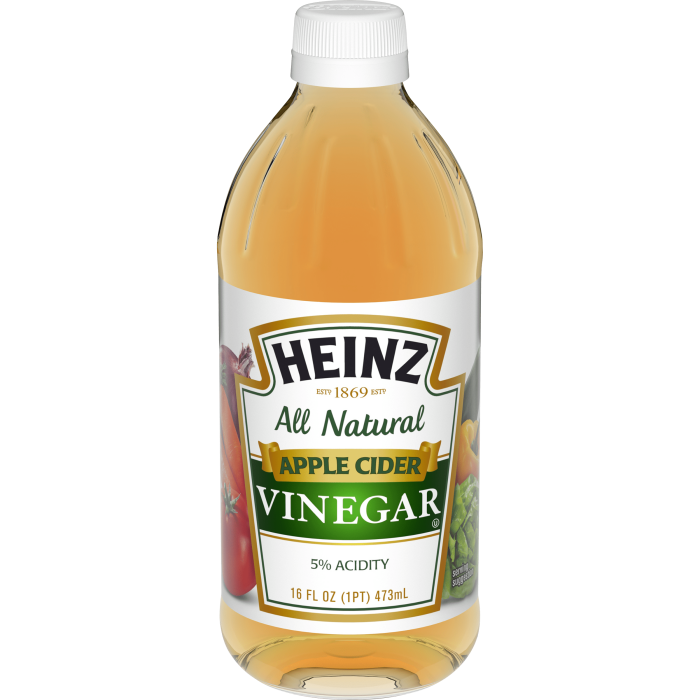
cider vinegar
Dressing
White vinegar is a clear, colorless liquid made from fermented grain alcohol that has a high concentration of acetic acid, making it useful for cooking, pickling, and household cleaning. It is also called distilled vinegar or spirit vinegar and is often used as a substitute for apple cider vinegar in baking when a less potent flavor or lighter color is desired. Culinary uses Baking: Used to provide leavening and can be a substitute for apple cider vinegar in baking recipes. Pickling: Its high acidity makes it ideal for pickling vegetables and other foods. Marinades and dressings: Can be used as a base for marinades and dressings, though its strong flavor may be too overpowering for some dishes. Cleaning and other uses Household cleaner: A popular and inexpensive disinfectant for cleaning surfaces, removing stains, and deodorizing. Laundry: Can be used as a natural fabric conditioner and stain remover. Gardening: Can be used to kill weeds. Coffee makers: Can be used to descale and clean coffee makers. Differences from apple cider vinegar Origin: Apple cider vinegar is made from fermented apples, while white vinegar is made from a variety of grains, such as corn, or other ingredients like potatoes. Flavor and color: White vinegar is clear and has a sharp, tart flavor, while apple cider vinegar is brown and has a more fruity flavor. Composition: Apple cider vinegar contains a small amount of potassium, but both types have a similar acetic acid level and are acidic and should be used with care.